
Storm Damage Tree Cleanup in Billings, MT
Storm damage tree cleanup in Billings, MT for fallen trees, broken limbs, blocked access, or tree debris from high winds, snow, or other weather events.
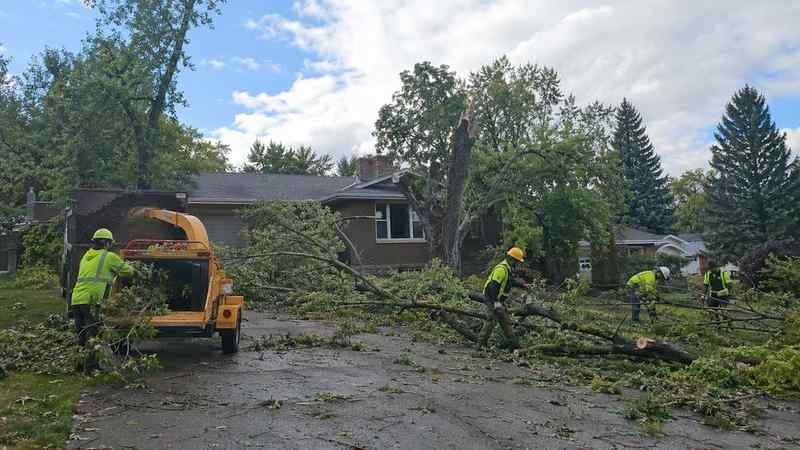
When winds, snow, or other weather events result in broken limbs, fallen tree sections, road or access blockage, or other storm-related damage, we offer storm damage tree cleanup in Billings, MT and the surrounding area. We will begin by assessing the most hazardous material and any access constraints; the fallen limb cleanup, chopping and hauling, and overall site restoration can begin right away.
Storm cleanup and emergency tree removal jobs sometimes overlap. If one tree or section is still precarious and poses a significant risk to the current surroundings, we’ll prioritize its removal or hazard mitigation first. On the other hand, if one tree sustained widespread branch damage, or the debris has hindered passage or other desired activity, we’ll formulate the required cleanup based on the branches, boughs, trees, and other materials that will need to be cleared, hauled away, and the site restored.
Storm Cleanup Is About Property Restoration
After a storm, the issue is rarely a single damaged tree. The limbs can be scattered throughout the yard, a tree trunk may have blocked the driveway, broken branches may still be suspended in the canopy, and several trees may have been damaged at once. Storm damage tree cleanup refers to all the tasks involved in returning the site to a normal state while distinguishing between hazardous and non-hazardous materials and organizing the order in which they should be cleared, cut, processed, and removed.
It is not the same as standard tree removal jobs; these are more about assessing the damage and addressing the concerns. The cleanup always begins with the conditions created by nature’s forces. For instance, what was sheared off by the wind or snowfall, what was compromised in the process, and what remains unstable or impedes on something else.

Common Weather-Related Tree Damage
Fallen trees or large tree sections
Strong winds or a combination of winds and saturated soil can cause whole trees to topple over. This happens when they fall in an open space, across the driveway, into or against a fence, or even on a structure, damaging it in the process. The root ball’s location relative to the tree, any bending that may have occurred, and the stored potential energy in the tree will make a fallen tree’s removal a unique challenge.
Branches that are broken but still attached
This is similar to a broken limb, but with the exception that it is still partially attached. The broken limb can shift after the storm has ended, particularly if the canopy is still being tossed around by the wind or the fibers are still fraying.
Canopies that are split, leaders that are broken
High winds, snow accumulation, or a combination of the two can cause damage to tree crowns by pulling apart the primary stem or shearing the leader. Another consideration is how much the remaining structure will be able to withstand the stress of its own removal.
Debris scattered around the yard
Although it is uncommon for a storm to affect just one tree, this is what many people are confronted with during a storm or immediately after. It refers to the accumulation of broken branches, twigs, firewood, leaves, and other detritus. It is necessary to clear the mess, cut the firewood to size, chip the twigs, remove the debris, and reopen gates, driveways, and other access points.
The Most Basic Safety Practices After a Storm
The safest course of action is to avoid damaged trees and branches and notify professionals who can assess the situation. It is best not to check broken branches by standing directly beneath them; it’s not a good idea to try to free up space by pulling or pushing branches or limbs that have gotten entangled in one another; or to attempt to climb or stand on bent branches or other unstable wood.
Damaged power lines should also be treated with caution. NW Energy recommends that people and animals stay at least 30 feet away from downed power lines and that equipment or objects should not touch or be near the downed or low-hanging power lines. Do not try to remove a tree or branch from a power line. If a tree or branch falls on a power line, contact NW Energy or emergency authorities.
What Does Storm Damage Tree Cleanup Consist Of?
Branches that have fallen onto yards, driveways, or accesses may need to be cut away.
Large sections of trees that can still be removed safely should also be considered.
Broken branches that continue to be attached or hang precariously.
Clearing tree debris from places such as fences, gates, sidewalks, parking lots, and other structures.
Brush chipping; brush, logs, and other debris disposal in accordance with the scope of work.
Evaluation of the remaining damaged trees for pruning, monitoring, and removal.
Stump work is set aside if the tree has failed completely and needs to be removed as well.
Our Storm Cleanup Guidelines
The first step is always to identify and secure unstable material, and areas where work should be avoided for the time being. Trees or branches that continue to sway, shifted root balls, uprooted trees, or those in contact with power lines have higher priority than simply removing tree debris from the yard.
The second priority is to re-establish access wherever possible; driveways, gates, parking spaces or areas, and work sites should be opened up whenever possible so that cleanup activities can begin. In some cases, access to the property may need to be established before any other form of cleanup can begin.
The third priority is processing branches, logs, and other debris in accordance with the scope of work while also reviewing all damaged trees for further action.
The Fourth Priority Is To Determine Hazards
Hazardous trees, branches, or other materials should always be addressed before initiating any other cleanup work. Hazardous materials or structures should be prioritized over general yard cleanup since they pose a greater risk of causing injury or damage to your property. Trees, limbs, and other objects that endanger structures, vehicles, and other objects should also be prioritized for removal.
The fifth priority is restoring access
A driveway, parking access, or other forms of access may need to be cleared so that the cleanup crew can gain access to the worksite or so that the customer can regain access to a structure or their property once the cleanup work is complete. Access is sometimes necessary to bring in or remove large equipment during the cleanup process.
The sixth priority is to remove or secure damaged trees or other materials.
Trees or their section that have broken should be prioritized over healthy trees that have been damaged in the process. Trees that were leaning before the storm or that have shifted considerably afterward are more likely to tip when removed and should be addressed first.
The seventh priority is the processing of debris such as brush, logs, and firewood, as well as the placement and removal in accordance with the scope of work.
The eighth priority is to conduct a follow-up inspection to see if any further action is necessary regarding the damaged trees.
Can a Storm-Damaged Tree Be Saved?
It is perfectly conceivable and common for a branch to break without the tree losing its ability to survive and thrive in the long run. It all comes down to whether the root ball, the trunk, and the tree’s main branch structure were compromised in the process. There will also be a consideration of whether the broken or dangling parts can be removed without leaving unsightly defects on the tree’s canopy or structure.
On the other hand, entire trees will have to be removed if the root plate has been uplifted, the trunk has split or been otherwise separated, more than half of the canopy’s stem structure has been lost, or if the remaining tree would pose a hazard to structures, vehicles, roads, or other elements. The distinctions between emergency tree removal and storm damage cleanup are discussed in more detail on the Emergency & Hazardous Tree Removal page.
Restoration of Driveways, Gates, Property Access
When a storm occurs, a tree limb that has fallen across a driveway is frequently the most immediate concern. A gate that has been obstructed by a tree is inaccessible to machinery. It is crucial to clear these access points before proceeding with the cleanup since they dictate the sequence in which everything else will be done.
On the other hand, if the tree has fallen on a building, a vehicle, or another object, it should not be removed from there in an effort to free up space. Another item, such as a building’s or vehicle’s structure, could well be carrying some of the tree’s weight, and an improper limb or branch removal would cause the entire tree to come down.
Tree Debris: Branches, Logs, Chips, and Hauling
It is crucial to remember that storm debris is voluminous. Even if a yard appears to have been littered primarily with twigs and branches, it will contain a disproportionately large amount of wood once it has been cut and removed. It is critical to understand that the cleanup and hauling scope must specify whether the brush has to be chipped, the firewood processed, the logs cut into specified lengths, and whether the chips and logs have to be removed or if they can be left on the site.
It is not a good idea to assume that a tree-debris site or tree-stump disposal site will be available if there has been a widespread community storm in the region. It is always a good idea to check with local authorities such as Billings Public Works to see if such programs, such as the one mentioned above, would be available following the storm. Tree debris sites tend to be temporary and only available in the wake of a large-scale community storm.
Storm Cleanup Vs. Emergency Tree Removal
The two services overlap but differ in terms of the main issue: emergency tree removal deals with a single tree, whereas storm damage cleanup focuses on the aftermath of the storm. Emergency tree removal service refers to a leaning, broken, fallen, or otherwise hazardous tree that has to be removed as soon as possible. When a storm causes a tree to fail, the cleanup process consists of removing broken branches and other damaged parts of the tree as well as restoring access and other storm-related damage.
When the main concern is the hazardous tree itself, it makes sense to use the Emergency & Hazardous Tree Removal page. On the other hand, if a storm has resulted in numerous damage and the customer wishes to have everything addressed, the Storm Damage Tree Cleanup page is the way to go.
Storms and Tree Damage in Billings
Storms of strong winds and thunderstorms have caused trees to come down in Billings, leaving branches scattered around the region and impeding access to homes. The cleanup operations conducted by the city in the wake of a storm are instructive in that they demonstrate that storm damage tree debris is frequently a community-wide concern rather than just a single yard or even a single tree.
It is important to note that different trees respond differently to weather conditions. Trees that were already weak or had structural defects before the storm were more likely to come down or sustain damage during the storm. When assessing the damage caused to a tree, it is crucial to compare it to how the tree looked before the storm in order to identify new developments, shifting patterns, and other irregularities.
This way of thinking also helps to distinguish between the different jobs. If one large tree has been broken or uprooted, removing it will be the priority. On the other hand, if several trees have been damaged in the same storm and each has different issues, these will have to be addressed in a specific order.
When it comes to emergency tree removal, the urgency will depend on a tree’s proximity to structures and how hazardous its condition is. Trees that are close to homes, overhangs, or other man-made constructions and pose an electrocution hazard should be removed before trees located in open areas that do not present an imminent threat.
When several trees present similar issues, the ones that failed most severely typically take priority over the ones that have only been sheared or broken in one place. If there is a tree that needs to be cut down for safety reasons, it usually takes precedence over one that needs to be trimmed because it is overhanging a street.
When Several Trees Are Injured At The Same Time
A tree that has fallen over a roof, fence, vehicle, or other object is not something that should be treated as regular firewood. The item over which it has fallen may well be supporting it, so cutting away at the tree’s limbs has the very real possibility of causing the entire tree to come down. The way to handle it will depend on how much the tree weighs and what the object underneath can support.
Storm cleanup jobs can be deceiving from the ground, but there are plenty of ways to get hurt if one attempts to remove a tree branch by branch. Avoid cutting back bent trees, pulling branches out of one another with machinery, climbing under broken branches, or going up a damaged tree in an effort to “free” a branch. Bending and twisting wood can cause stored energy to be released, causing the branch to come loose and fall on someone.
What Not To Do About Storm-Damaged Trees
A storm cleanup job is not something that requires constant troubleshooting. It is more of a second look at things after the mess has been cleaned up. Just because the main branch has been removed does not mean the tree is no longer a hazard; the follow-up will ensure that. If the remaining tree does not look stable, it might be a good idea to arrange for a separate hazard assessment rather than waiting for the cleanup to finish.
There are some hazards that reveal themselves right away, and there are some that take more time to appear. A crack that develops over time is not going to stop on its own, just like a broken branch that has already lost its support system. After the storm and the initial cleanup, inspect the remaining canopy from the ground for new cracks, branches, and other signs of instability.
Cleanup Following A Storm That Has Already Passed
What Influences On The Price Of Storm Damage Repair?
Unlike typical tree damage, which is calculated based on the species and height of the tree, storm damage jobs are more concerned with assessing the situation and estimating the total number of hours needed to complete the project.
Number of damaged trees and amount of debris
The size and weight of individual limbs or tree sections that have been sheared off.
Whether the damaged limbs or sections are on the ground or still on the tree.
Whether there are any obstacles like gates, roads, or other structures.
The distance from homes, power lines, fences, or other objects.
The tree’s or branch’s proximity to structures.
Necessity of using climbing equipment, aerial equipment, or controlled lowering methods.
The grade of the ground after rain or snow.
Amount of chipping, log cutting, and debris removal.
Whether there is a stump to be removed or if another tree has to be removed in addition to the storm-damaged one.
Request Storm Damage Tree Cleanup in Billings
Use the form below or call to request a cleanup for fallen limbs, tree sections, blocked access, and other storm-related issues after a major weather event. In case of an immediate hazard caused by a leaning or broken tree, use our Emergency & Hazardous Tree Removal service.
Frequently Asked Questions
What should I do after storm tree damage?
Stay safe, avoid unstable trees, and request professional inspection.
Can storm damaged trees recover?
Some recover with pruning and care, while others become unsafe.
Does insurance cover storm tree removal?
Coverage depends on your policy and damage situation.
Why are storm damaged trees dangerous?
They may contain hidden cracks, weak branches, or unstable roots.
Request Tree Service in Billings, MT
Call for tree service help or use the estimate form on our Contact page. If a tree is actively failing, see Emergency & Hazardous Tree Removal instead.
Get a Fast, Free Estimate
Tell us about the job and we will get back to you.