
Tree Removal Services and Related Property Work
We offer tree removal and related services throughout the Billings area for issues ranging from single trees that need to come down, trees that need pruning, stumps, storm damage, and land clearing. You don’t have to know what the tree problem is or what service you need before contacting us. Tell us what you see or what the tree is near and what you want the tree to look like
Use the options below to narrow down what you might need. Each one will help explain what the service includes, how the work will be approached, access and utility issues, clean up, cost considerations, and when another service might be better.
Start With the Problem, Not the Service
Chances are, you don’t start with a well-defined service. The tree leans a little more than last year or has a large branch over your roof. The stump gets in the way of your lawnmower or the neighbor’s dog keeps digging at it after the last snowstorm. Tell us what you see and where it is, and what is around it. It may be easier to describe exactly what the problem is than to figure out which kind of service it is.
When requesting service, let us know what you see, where it is, and what is around it. A description will help decide if the tree needs standard removal, emergency work, pruning, stump grinding, storm cleanup, or land clearing.
Emergency & Hazardous Tree Removal
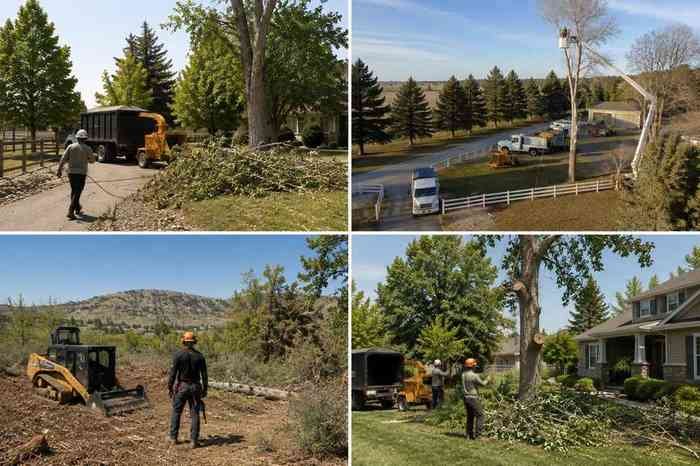
Emergency and hazardous tree removal deals with trees that have an active problem that has the potential to cause damage or injury. Tree failure can involve the entire crown and root system coming down or just large branches breaking off and falling. The failure can be caused by wind, ice, snow, rain, a leaning tree, roots lifting the trunk off the ground, or the tree just failing for no apparent reason. The tree can be dangerous on the ground if it falls across the house, garage, car, fence, or other structures or in a heavily traveled area. Emergency tree work can also be caused by a recent storm that leaves broken branches or trees scattered around the property.
The work is not as simple as just getting the tree on the ground. The hazardous work is determined by the direction the tree will fall, what is around the tree, the space to work with, access to the tree, branches that could hang over the house during the fall, and what control can be exerted during the fall. If the tree is falling or is an immediate danger, please go to the Emergency & Hazardous Tree Removal
Tree Trimming & Pruning
Tree trimming and pruning should be considered if the tree is desirable but needs to be kept smaller or thinned out. This can include the removal of dead branches, broken branches, crossing branches, or low-hanging branches. The tree may have a branch that is too close to the house or a long limb that causes it to lurch forward when it gets windy. Thinning or trimming the tree allows it to keep its natural shape while removing problematic branches.
Pruning should be done for a reason such as, removing dead or unwanted branches, branches that are rubbing together, or interfering with a structure or the natural shape of the tree. Just taking some branches off the tree because it has too much leaf growth is not the same as structural pruning. The Tree Trimming & Pruning page goes into more detail about reasons for trimming, pruning, and timing of each, as well as clean up and when tree removal might be a better option.
Stump Grinding
A tree may have been removed, but the job is not complete because the unsightly, unusable stump is still there. The height of the stump can be an impediment to things such as a lawnmower, a fence, or a planned building site. The stump can also be an eyesore. Stump grinding can get rid of that problem. The stump may not always be completely ground down to ground level, depending on the grinder, the diameter of the stump, and the flare at the base of the stump.
There are multiple considerations for stump grinding such as the diameter of the stump, the flare at the base, the proximity to other objects, machine accessibility, and what the client would like to do with the area when the project is done. These topics and more are discussed in the Stump Grinding article.
Storm Damage Tree Cleanup
Storm damage usually refers to wind and snow damage but can occur with other weather problems. Downed limbs or trees can cause problems like a blocked driveway or tree debris scattered throughout the yard. The storm can also cause branches to hang precariously over the house and large trees to fall across the house. The cleanup involves the removal of debris as well as any hazardous trees or branches that may be a threat until a professional tree service can remove them.
The main difference between storm damage and an emergency is that an emergency involves an unsafe tree that needs to be removed while a storm cleanup is about getting the usable parts of the tree that have been damaged down and removing the non-usable parts. There are also times when both jobs need to be done, first getting down the immediately hazardous tree and then cleaning up the remaining debris. If both are an option, the hazardous material is addressed first.
Land Clearing
Land clearing usually refers to a specific parcel of land to be cleared of trees, brush, debris, and other unwanted materials to prepare it for something else. That something else could be development or just making the area around the house or structure more desirable. Land clearing may be needed when the overgrown trees, brush, and junk make the area around the land unusable.
A land clearing job should be started by considering what the client wants the land to look like when it is done because the desired end result can affect the type of work it takes to get there. How many trees, the density of brush, the slope of the land, and what the client wants the land to be used for can all be determining factors. Land clearing differs from regular tree service in that the entire problem area, density of brush and trees, access to the land, and how the client wants it to look all need to be considered together. Land clearing does not include grading or other earth-moving activities that may need to be considered separately.
How These Services Can Connect
While a single property can need multiple services, they are best kept separate for simplicity. The reason each page is separate is that the goals for each one are different.
• Tree removal can precede stump grinding if the stump will be a problem
• Storm damage cleanup can involve emergency tree removal and branch clean up
• Pruning may be the answer for branches that are too long or problematic
• Land clearing, brush clearing, and stump grinding can all accompany tree removal for a larger project
• A hazardous tree evaluation may reveal that only limited branches need to come off the tree but a failed tree is best removed entirely
Not sure which service fits? Here’s a quick guide:
Tree service:
- Dead tree, unwanted tree, or problematic tree: Tree Removal
- Leaning tree, split tree, fallen tree, or tree that has the potential to fall: Emergency & Hazardous Tree Removal
- Tree that is staying but needs branches removed or thinned: Tree Trimming & Pruning
- Stump left after tree removal that is causing a problem: Stump Grinding
- Branches, fallen tree, or debris left after a storm: Storm Damage Tree Cleanup
- Multiple trees, brush, stumps, and junk over a large area: Land Clearing
Information to Have Ready Before Requesting Service
A short description of the problem is all we need to get started. Be sure to give us an idea of where it is (Billings area), what service seems to fit the problem, if the tree is up or down, size, any damage, what is nearby, and any other restrictions such as small gates or the desire to have the stump ground up. If the problem is a storm or emergency issue also tell us if anything is blocking the way or seems unsafe. NEVER attempt to trim or cut any tree or branch that may be in contact with a power line. NW Energy recommends staying away from down or low hanging lines and NOT attempting to remove a tree or branch in contact with an energized line. Call your power company or the emergency number if a power line is down.
Service Area
We provide services in Billings and the surrounding areas such as Billings Heights, Lockwood, Laurel, Shepherd, Huntley, and more. Tree removal and other jobs can require access, working space, structures, utilities, and clean up considerations that vary from place to place throughout the area. Please keep that in mind when requesting service
Request Tree Service in the Billings Area
If you know what service you need, go to your preferred page to read more about the type of work and then fill out the request form at the end. If your tree issue does not seem to fit into one service, describe the problem and what you would like the finished product to look like. Your request can then be routed to the appropriate service department.
Call for Service | Request an Estimate
Request Tree Service in Billings, MT
Call for tree service help or use the estimate form on our Contact page. See our Service Areas page for coverage across the Billings region.
Get a Fast, Free Estimate
Tell us about the job and we will get back to you.